Saigon Central Post Office (Bưu điện Trung tâm Sài Gòn) is a French colonial landmark, completed in 1891, and it is still a working post office today. It stands on Paris Commune Square in central Ho Chi Minh City, directly opposite Saigon Notre-Dame Cathedral Basilica, so we usually recommend seeing the two together.
Entry is free. You can walk into the main hall, look at the painted maps on its walls, and buy stamps or post a card at the counters. Plan on 30 to 60 minutes. Many guides say that Gustave Eiffel designed the building. He did not, and the History section below explains who did.
Quick Facts
| Detail | Information |
|---|---|
| English name | Saigon Central Post Office |
| Vietnamese name | Bưu điện Trung tâm Sài Gòn |
| Address | 2 Công trường Công xã Paris (Paris Commune Square), Sài Gòn Ward, Ho Chi Minh City (formerly Bến Nghé Ward, District 1) |
| Built | 1886-1891 |
| Architect | Marie-Alfred Foulhoux |
| Entry | Free |
| Opening hours | Monday-Saturday 7:00 am-6:00 pm; Sunday 8:00 am-5:00 pm |
| Time needed | 30-60 minutes |
| Look out for | Two painted maps, the vaulted iron-framed ceiling, wooden phone booths, a portrait of Ho Chi Minh at the far end of the hall |
Getting there
The post office is in the middle of Ho Chi Minh City's main sightseeing area, so it is easy to reach from most central hotels. The main entrance faces Notre-Dame Cathedral across the square, and Nguyễn Văn Bình Book Street is a few steps away.
If you are staying nearby, walk. From further out, take a taxi or a ride-hailing car and give the driver the Vietnamese name, "Bưu điện Trung tâm Sài Gòn", or "Công trường Công xã Paris". The cathedral is the easiest landmark for meeting a driver afterwards. Some older maps and drivers still say "District 1"; it is the same place.
Opening hours and best time to visit
The post office is open from 7:00 am to 6:00 pm from Monday to Saturday, and from 8:00 am to 5:00 pm on Sunday. As it is a working public building, opening hours may change during public holidays, including Tết, national day or any other official Vietnam Public Holidays. If you are travelling during a holiday period, please contact your travel consultant for the latest information and detailed arrangements. Our itineraries are carefully planned around public holidays, with visits scheduled on the days when each attraction is open and other suitable experiences arranged on the remaining days, ensuring that you can make the most of your trip without missing out on the places you want to see.
We recommend going in the morning or the mid-afternoon. Midday is the hottest part of the day in Ho Chi Minh City, and the hall and the walk on to the cathedral and Book Street are more comfortable when you are not hurrying through the heat.
What to see outside
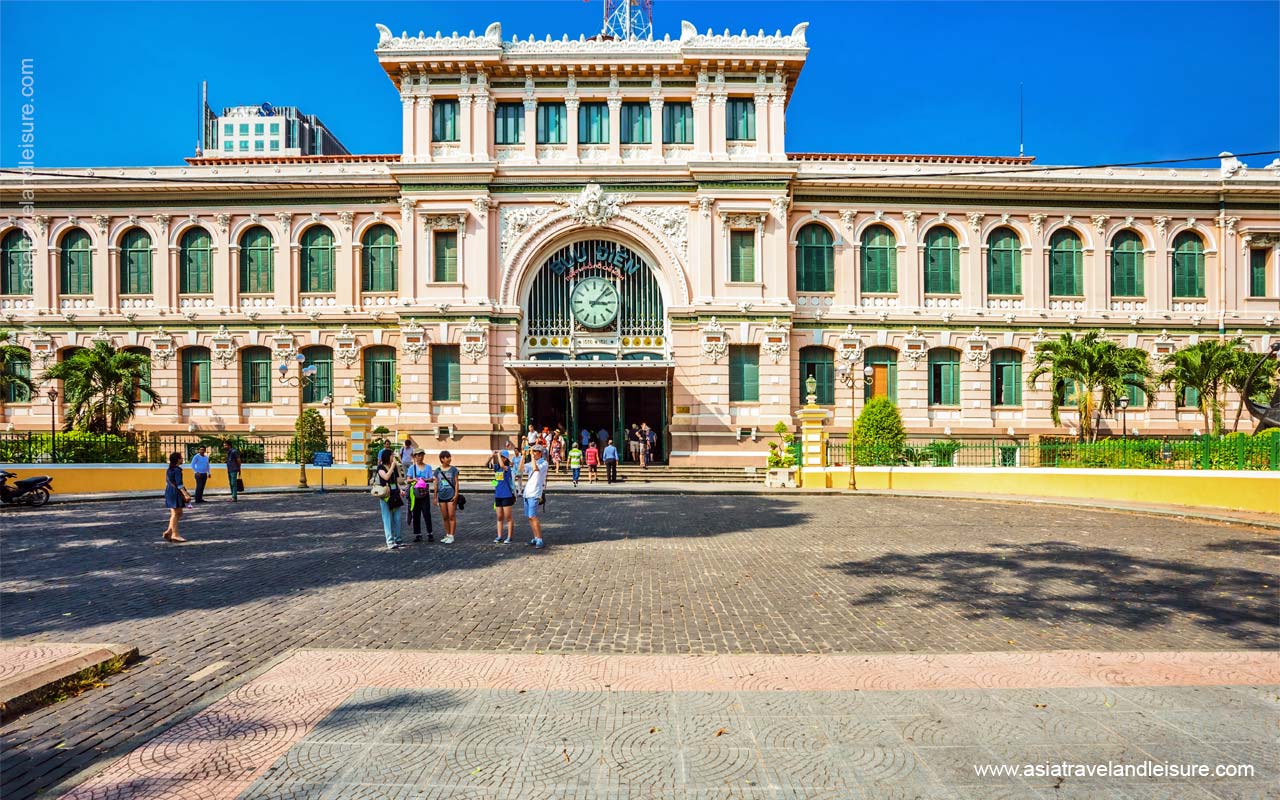
Take a minute to look at the façade from the square before you go in. It is pale yellow with white trim and green shutters, tall arched windows and a large clock over the entrance. A plaque above the entrance gives the building years, 1886-1891, and between the windows you can read the names of pioneers of telegraphy and electricity, Alessandro Volta among them.
What to see inside
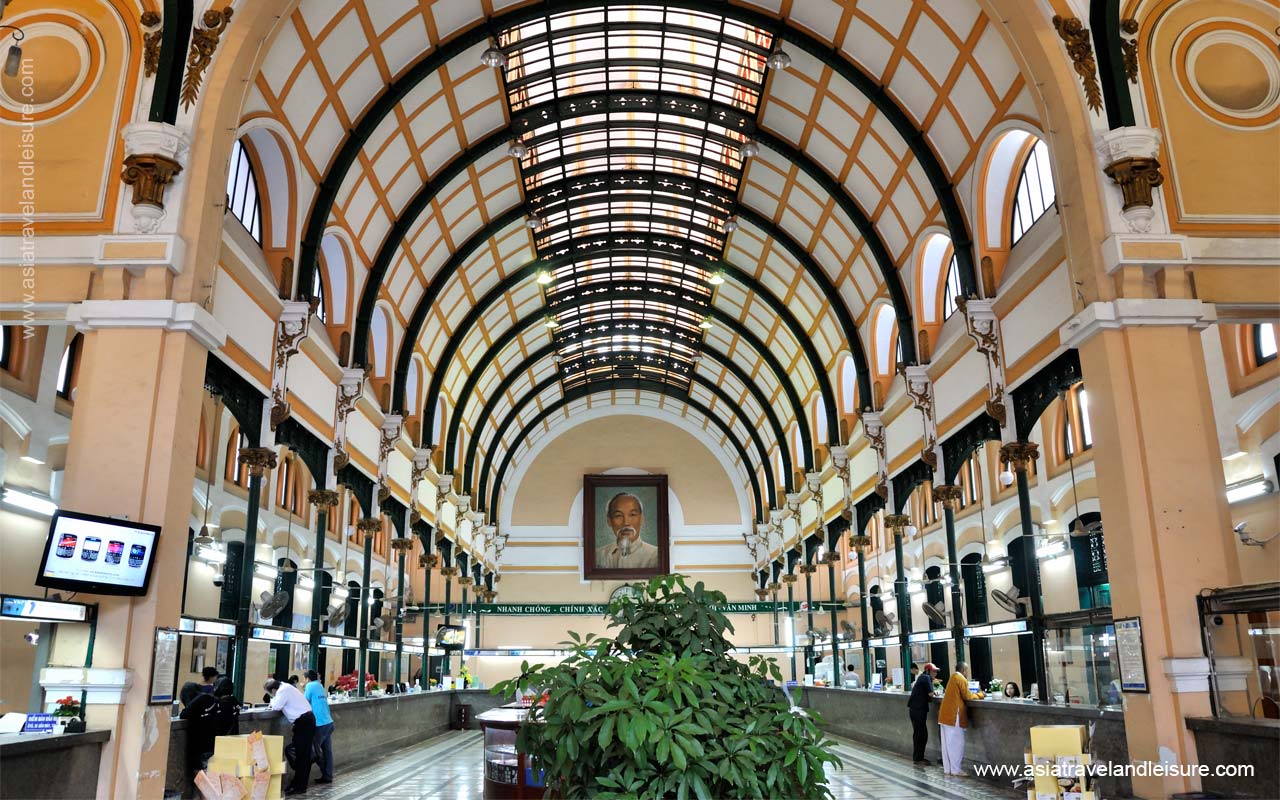
The hall is long and high, with a vaulted ceiling carried on a prefabricated cast-iron frame, iron columns painted green, and a patterned tile floor. Old wooden phone booths line the sides, and at the far end a large portrait of Ho Chi Minh hangs on the wall. Because it is a working branch, you will be sharing the hall with people sending parcels and buying stamps.
The two painted maps
Two large maps are painted high on the hall walls. One, Saigon et ses environs (1892), shows the city and its surroundings under French rule. The other, Lignes télégraphiques du Sud Vietnam et du Cambodge (1936), shows the telegraph lines across southern Vietnam and Cambodia. Both are labelled in French, and together they show what this hall was built to do: connect Saigon to the rest of the region and to France.
Post a card home
The counters belong to a working Vietnam Post branch, so you can buy stamps and post postcards or letters from here. The staff can tell you the postage to your country. Postcards and souvenirs are also sold by vendors inside the hall.
Since 30 September 2025 there has also been a photo booth called Tem Booth in the hall (tem means "stamp"), run with the partner company Wis Corner. It prints your photos as personalised stamps or postcards, and the personalised stamps can go on your mail alongside regular postage.
History and architect
Saigon's postal and telegraph services began in the 1860s, and the first stamps were issued in 1864. The earlier building could no longer keep up with demand, and work on the present one began in 1886. It was inaugurated in July 1891.
The architect was Marie-Alfred Foulhoux (1840-1892), Architect-in-Chief of Cochinchina, who also designed the Palais de Justice and the Lieutenant Governor's Palace in Saigon. The post office was his last major work.
It was not designed by Gustave Eiffel. The French journal Architecte constructeur, reporting on the inauguration in September 1891, credits Foulhoux, and the historian Tim Doling has published a translation of that report. You may also come across the name of Auguste Henri Vildieu, an architect based in Hanoi, in Vietnamese-language sources; the 1891 report names Foulhoux alone.
Nearby: a walk around the centre
The post office fits easily into a morning on foot. The order we suggest is:
- Saigon Notre-Dame Cathedral Basilica: directly across the square from the post office doors.
- Nguyễn Văn Bình Book Street: a pedestrian street of bookshops and cafés beside the post office, a good place for a coffee.
- Reunification Palace: the former presidential palace of South Vietnam. It was completed in 1966, and a North Vietnamese tank crashed through its gates on 30 April 1975, at the end of the war. It is a short walk from the post office.
- Ben Thanh Market: the city's best-known central market, and a longer walk on from the palace.
Our advice
Treat the post office as a short, easy stop rather than a half-day visit. See it with the cathedral and Book Street in the morning, add the Reunification Palace if you have time, and finish at Ben Thanh Market. If you are already booked with us, your travel consultant can fit the post office into your Ho Chi Minh City itinerary on a day when it is open. If you are still planning your trip, contact our team and we will help you build it in.